
In January 2026, an artificial intelligence (AI) tool analyzed nearly 100 million Hubble Space Telescope images and identified more than 800 cosmic anomalies that had remained hidden for potentially 35 years — completing the search in just two and a half days.
That kind of discovery marks a turning point for AI in space. The technology is becoming an active layer of mission support— helping spacecraft navigate, satellites monitor their own health, crews receive support, and scientists uncover patterns that were previously out of reach.
This article explores where AI is already transforming space operations, what opportunities and risks it creates for the industry, and what these changes demand from the engineers responsible for building safe, secure, and mission-ready systems.
Spacecraft Autonomy and Deep Space Exploration
In deep-space missions, autonomy does not replace human expertise — it extends it. As spacecraft operate farther from Earth, AI can help teams manage distance, delay, and uncertainty by enabling systems to respond more intelligently between ground commands.
Autonomous Navigation
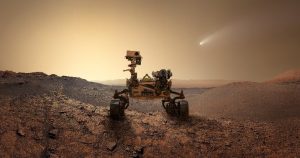
NASA’s Perseverance Rover
NASA’s Perseverance rover, which has been exploring Mars since 2021, is already demonstrating that shift. Its driving is now 88% autonomous, using onboard computer vision to identify hazards and navigate without constant ground input. Earlier this year, it went further, completing the first Mars drives planned end-to-end by generative AI, with no human route planners creating the waypoints.
That same shift is shaping other missions, too. The European Space Agency’s (ESA’s) Hera spacecraft is designed to autonomously navigate around the Didymos-Dimorphos asteroid system, using visual tracking, lidar-based altimeter readings, inertial sensors, and star-tracker measurements to understand its position and operate safely in a complex, low-gravity environment.
Astronaut Assistants
As missions move farther from Earth, crews will need AI support inside the spacecraft, too. Communication delays and blackouts can make real-time medical or operational help from Earth difficult when immediate guidance is needed.
Google and NASA’s Crew Medical Officer Digital Assistant (CMO-DA) addresses that challenge directly. The multimodal AI system is trained on spaceflight medical literature to help crews diagnose and treat symptoms without physician contact.
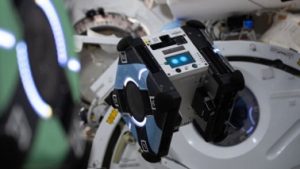
AI-enabled crew support is also advancing through robotics. On the International Space Station (ISS), Stanford researchers used machine learning to improve motion planning for Astrobee, NASA’s free-flying robotic assistant, reducing autonomous movement planning time by 50–60%.
Spacecraft Health

Mega-Constellation Coverage. (Photo/Courtesy: ESA Science Office)
Mega-constellations make manual satellite health monitoring impossible at scale.
With the satellite count projected to grow from roughly 15,000 today to 100,000 by 2030, operators need AI systems that can analyze telemetry, flag anomalies, predict component failures, and assess fuel margins before issues disrupt operations. In April, The Aerospace Corporation and Google Public Sector announced a proof-of-concept AI tool for constellation operations designed to handle the high-velocity demands of modern space domain awareness while helping on-call engineers to “focus their expertise where it matters most,” according to Kevin Bell, senior vice president of Aerospace’s Engineering and Technology Group.
Space-Based Data Processing and Discovery
A Growing Data Bottleneck
As the number of satellites in orbit increases, space missions are producing more data than traditional ground-based workflows can process quickly. NASA’s Earth observation archive has already crossed 100 petabytes (PB) and is projected to reach 320 PB by 2030, while Europe’s Copernicus program holds more than 78 PB. At that scale, the challenge is not just collecting data — it is moving, filtering, and interpreting it fast enough to support time-sensitive use cases like disaster response and large-scale scientific discovery.
AI At the Edge
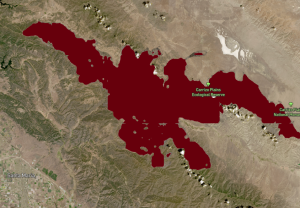
Prithvi predicted burn scar impacts from the Gifford Fire near Los Angeles (August 17, 2025). (Photo/Courtesy: NASA)
One solution is edge computing: By running edge AI directly on satellites and connecting it with cloud-to-edge workflows on the ground, space systems can process data closer to where it is collected instead of routing everything back to Earth for analysis. In May, researchers from Adelaide University, ESA’s Φ-lab, and Thales Alenia Space deployed NASA and IBM’s Prithvi geospatial AI foundation model into orbit, validating it aboard the ISS and the Kanyini satellite. By supporting tasks like flood mapping, cloud detection, burn scar identification, and disaster monitoring onboard, Prithvi helps move satellite data from observation to actionable intelligence in near-real time.
Cosmic Discovery
AI is also changing how scientists search the universe. AnomalyMatch, an AI-powered discovery tool designed to identify unusual objects in astronomical image archives, used an unsupervised neural network to scan the Hubble Legacy Archive and surface more than 800 previously undocumented objects — including gravitational lenses, galaxy mergers, and unclassified anomalies — that manual review could not have found at that scale. As missions like Euclid, the Vera C. Rubin Observatory, and the Nancy Grace Roman Space Telescope generate even larger datasets, AI-assisted discovery will become essential to the science pipeline. NASA’s ExoMiner++ model is applying a similar approach to Transiting Exoplanet Survey Satellite (TESS) data, using AI to sift through brightness measurements and help scientists identify promising planet candidates more efficiently than manual review alone.
The New Frontier: Orbital Data Centers
As demand for AI processing grows, companies are beginning to look at orbit as a potential answer to the power, cooling, and scaling limits facing terrestrial data centers.
 In January, SpaceX filed plans with the FCC for up to one million orbital data center satellites operating between 500 km and 2,000 km. The proposed architecture would rely on solar power, radiative cooling, and high-bandwidth optical links through Starlink to support AI workloads in orbit. SpaceX has framed orbital data centers to meet accelerating AI compute demand, with projections of up to 100 gigawatts of annual orbital compute additions if Starship becomes fully reusable at scale.
The concept is still highly experimental. Other organizations, including ESA-backed initiatives, Axiom Space, Starcloud, and Google’s Project Suncatcher, are exploring related ideas, but major barriers remain around radiation, latency, debris, servicing, cost, and commercial viability.
Still, the direction is significant: What was once a speculative space concept is now being evaluated as a potential response to the power, cooling, and scale constraints facing data centers on Earth.
Governance and Cybersecurity
Autonomous spacecraft, orbital data centers, and AI-enabled satellite operations can improve speed and resilience, but they also introduce new risks around system access, decision authority, accountability, and trust.
The answer is not to avoid AI, but to deploy it responsibly — with secure software practices, defined decision boundaries, decision logging, risk-based safety assessments, and clear human oversight. For organizations building mission-critical space systems, partners like Performance can help bring the engineering discipline, cybersecurity focus, and high-assurance practices needed to use AI safely and effectively.
What Comes Next
The space economy reached $613 billion in 2024 and is projected to grow to $1.8 trillion by 2035. Realizing that growth will require AI systems that can operate reliably in mission-critical environments, where failure carries technical, financial, and operational consequences. Success will depend on more than AI adoption — it will depend on engineering workflows that can move faster while maintaining the discipline aerospace and defense (A&D) programs require.
Performance develops mission-critical software for commercial aviation, space, and defense programs. Our AI-first workflows are built with governance and guardrails from the start, combining elite engineering talent with AI-assisted development at scale to deliver secure, certifiable systems faster — without compromising assurance.
Ready to move at the speed of AI while maintaining the rigor your program demands?