
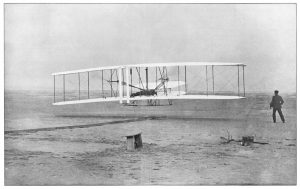
Every August 19, the U.S. celebrates National Aviation Day — a chance to reflect on how far flight has come since Orville and Wilbur Wright’s first controlled flight in 1903. In honor of the day, here’s a look at a timeline of significant software advances in aviation history — and a few real programs where Performance Software has helped keep aircraft on schedule and in the air.
A Brief History of Software Advancements in Aviation
1950s: Hughes Aircraft’s “Digitair” became the first airborne digital computer, designed to help guide Air Force interceptor jets through automated combat maneuvers — though most aircraft of the era still relied on manual, mechanical controls.
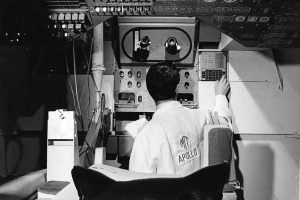
Photo Courtesy: MIT Museum
Early 1960s: Aerospace and defense programs became the first major users of integrated circuits (ICs). In 1962, Texas Instruments developed custom ICs for the Minuteman II missile guidance system, while the Apollo Guidance Computer, designed by MIT’s Instrumentation Laboratory for the Moon missions, became the first operational computer built with silicon ICs to fly aboard a spacecraft.
Early 1970s: The U.S. Air Force flew an analog fly-by-wire system aboard the YF-4E Control Configured Vehicle, a modified Phantom II, in May 1972 — testing what flying by wire, rather than mechanical linkage, actually felt like in the air. Three weeks later, NASA test pilot Gary Krier flew the F-8 Digital Fly-By-Wire (DFBW) research aircraft on what’s considered the first flight of a plane controlled purely by a digital computer. Its only backup was a separate three-computer analog system — one that, notably, was never needed for that flight or any other in the program’s run.
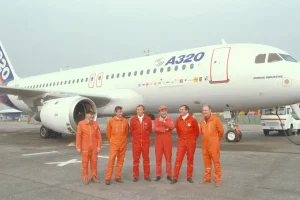
Crew members stand beside the first Airbus A320 after its debut flight in 1987. (Photo Courtesy: Airbus)
1980s: The first transatlantic flight using Global Positioning System (GPS) navigation was completed in 1983, when a Rockwell Collins Sabreliner flew from Cedar Rapids, Iowa, to the Paris Air Show in Le Bourget, France, using early GPS positioning for guidance. Additionally, in 1988, Airbus introduced the A320, the world’s first commercial aircraft to feature full digital fly-by-wire flight controls.
1990s: In 1992, The Radio Technical Commission for Aeronautics (RTCA) and the European Organisation for Civil Aviation Equipment (EUROCAE) published DO-178B, the first formal, widely-adopted certification standard for safety-critical aviation software.
2000: In 2000, the Federal Aviation Administration (FAA) mandated Terrain Awareness and Warning Systems (TAWS) for turbine-powered aircraft — software that cross-references onboard terrain databases to predict a collision before it happens, replacing the older Ground Proximity Warning System’s more reactive approach. From 1999 to 2019, the rate of CFIT accidents in airlines reduced by 89%.

Photo Courtesy: Boeing
2011: The Boeing 787 Dreamliner entered service running roughly 6.5 million lines of software code across its avionics and onboard support systems — up from about 2.6 million lines on the 777 in 1995, and just 400,000 on the 747-400 in 1988. The jump reflects how much of a modern aircraft’s function now lives in software rather than hardware.
Additionally, in 2011, DO-178C replaced DO-178B as the primary standard by which certification authorities — including the FAA, European Union Aviation Safety Agency (EASA), and Transport Canada — approve commercial software-based aerospace systems, adding guidance for model-based design, object-oriented programming, and formal verification methods.
2020: EASA published its first Artificial Intelligence Roadmap for aviation, laying out a phased path toward certifying artificial intelligence (AI)-assisted systems — with a long-term vision of autonomous commercial flight by 2035 (EASA followed up with and updated Artificial Intelligence Roadmap 2.0 in 2023).
Today: AI-assisted engineering is steadily making its way into safety-critical development, DO-178C-certified programs included — like at Performance Software, where AI supports requirements, coding, and testing workflows with secure governance.
How does Performance Software support aviation programs?
Since 1998, we’ve supported major Original Equipment Manufacturers (OEMs), avionics suppliers, and systems integrators in meeting aggressive schedules and technical requirements on safety-critical aircraft programs. That support scales both ways — from smaller, specialized efforts that need a focused team of experts, to large programs that require rapidly scaling up engineering capacity to meet a critical deadline. Here’s how that’s played out on a few real programs:
Flight Management Systems (FMS): When a major systems supplier fell behind on preparing an FMS for first-flight integration with a U.S. military combat helicopter, they risked missing a critical U.S. Army milestone. Performance Software took on a Firm-Fixed Price contract to absorb the project risk, scaled the engineering team 8x as the scope grew from 200 to over 7,100 technical requirements, and built custom tooling to accelerate testing. The result: the client’s schedule was pulled in by four months (a 44% reduction), more than $2 million in potential delay costs were avoided, and the client came back for two additional programs.
In the client’s words: “We could not have met the critical milestone without you.”
Flight Control Systems (FCS): When a top commercial aircraft OEM needed to accelerate a flight control software program by a full year, the avionics supplier managing the effort brought in Performance Software. Within the first week, the team was already contributing design, code, and test work — and earned value metrics soon showed Performance Software outperforming every other vendor team on the project, including the client’s own resources. The client reallocated work accordingly, and Performance Software’s efficiency tooling ultimately saved the program $1.5 million combined across the initial effort and two follow-on fly-by-wire programs.
Communication Systems: An OEM racing toward an early Extended-range Twin-engine Operations Performance Standards (ETOPS) certification and first-flight deadline needed a critical avionics supplier’s major software update to stay on track. Performance Software partnered directly with the supplier’s team, taking on 100% of the software development effort and 75% of testing to keep the program moving. The upfront integrated engineering plan saved the client 20–30% in costs (roughly $1.1 million), every milestone was hit on time, and the aircraft’s first flight was a success.
In the supplier’s words: “Congratulations to your leadership and the entire Datalink Engineering Team for ensuring this program kept on track, culminating with a successful flight test.”
Want to learn more?
Whether you’re facing a tight certification deadline or need extra engineering capacity, contact us today to talk about your next program.